
Sacramento County Criminal Court Cases
The Superior Court of California, County of Sacramento hears both felony and misdemeanor cases. Criminal pretrial departments sit at Lorenzo Patiño Hall of Justice, where the court also operates Domestic Violence Court and Drug Court. Once a prosecutor files charges, the court creates a case number and a docket that tracks hearings, pleadings, rulings, the outcome, and any sentence. That court file is distinct from the arresting agency's report and the Sheriff's booking record.
Sacramento County criminal court cases may be heard in more than one building as they move through the system. The court's Criminal Division overview identifies the criminal locations and divisions. The Criminal Records Unit, not the Sheriff's Office, is the custodian for copies of filed Sacramento Superior Court cases. Start with the court index when the goal is to learn whether charges were filed or how a filed case ended.
Sacramento Criminal Public Case Access
The court's Criminal Public Case Access covers Sacramento Superior Court criminal filings from 1989 to the present. Search and document download fees have been discontinued. Results are limited to this county's court cases. They do not supply an arrest history, federal records, cases from another county, or a fingerprint-confirmed identity match.
Exact criteria matter when names are shared. The court cannot use fingerprints to confirm that a person in an index is the person a searcher has in mind. Compare the case number, filing period, division, visible events, and other lawful identifiers. The Sacramento County Public Portal adds searches by party, case number, calendar, or case type and date, plus requests for notice when a new document is added.
The court's Criminal Public Case Access screen is the source for this Sacramento County court image.
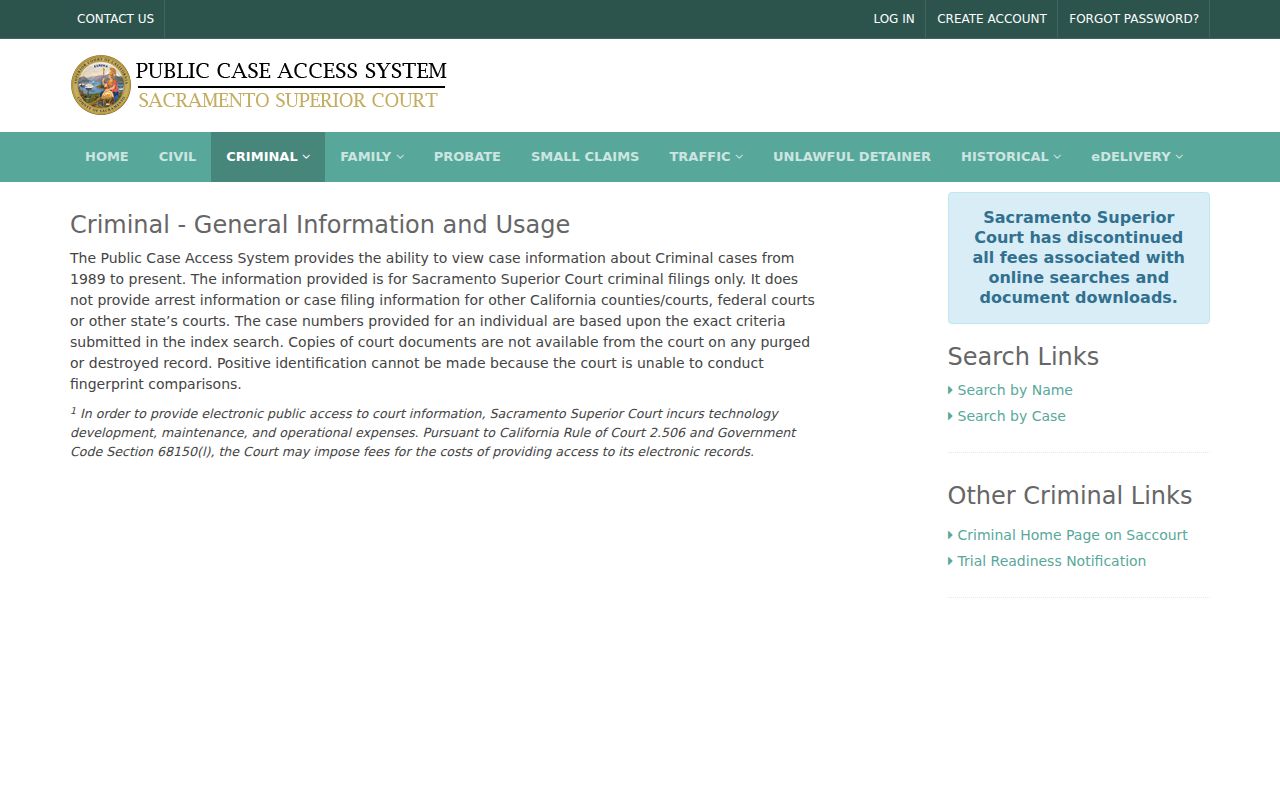
It marks the boundary clearly: the index covers Sacramento Superior Court criminal filings, not arrests or cases from other jurisdictions.
Searching Sacramento County Case Records
A Sacramento County criminal case search works best with a case number. A party name can locate a newer case when the number is unknown, while calendars and case-type filters help narrow the Public Portal. Read the result as a court index. A match means the court has a filing under those criteria, not that the search independently confirms identity or proves every allegation.
- Open Criminal Public Case Access and choose the name or case-number route.
- Enter exact criteria. Try the full case number first when it is available.
- Use the Public Portal's calendar, case-type, or date tools when a name yields too many possible cases.
- Open the case and read events in order, paying close attention to disposition and sentencing entries.
- Ask the Criminal Records Unit for plain or certified copies when the online entry does not supply the document needed.
| Field Label | Type | Required | Notes |
|---|---|---|---|
| Party name | Text | One search path | Use exact criteria; a name is not fingerprint identification. |
| Case number | Text | One search path | Best key for a known Sacramento County case. |
| Calendar | Date/list | No | Public Portal option for scheduled matters. |
| Case type and date | Filter | No | Narrows Public Portal results by filing category and period. |
| Case notifications | Request | No | Portal feature for activity when a new document is added. |
Sacramento Criminal Records Unit
The Criminal Records Unit at 500 G Street is the fallback when an online result is not enough. If the case number is unknown, submit Local Criminal Records Name Search Request CR-278A in person, by mail, or by email to CrimRecordsRequests@saccourt.ca.gov. The fee is $15 for each name. A public request that combines a name search with certified copies costs the $15 search fee plus $40 for certification.
When the case number is known, a requester may order a file by phone, then call 916-874-8881 to check delivery status. The unit holds a retrieved file for ten days. Mail and email copy requests use the court form and payment. Public fax requests are not accepted, and off-site files can take up to 30 days. These details make the Records Unit the practical source for paper documents, certification, and files not fully displayed online.
Criminal Records Unit
Tani G. Cantil-Sakauye Sacramento County Courthouse
500 G Street
Sacramento, CA
916-874-8881
Inside a Sacramento County Case File
A Sacramento County court file records litigation, not the full criminal history held by California DOJ. It may show the complaint or later charging document, court dates, pleas, motions, rulings, disposition, and sentence. Visible documents vary by case and portal rules. Use the final disposition rather than an early charge line to understand the court's result.
| Case Number and Court | The unique court key, criminal division, and local case identity. |
|---|---|
| Charging Document | A complaint, information, or indictment stating filed allegations. |
| Docket Entries | A dated log of filings, appearances, orders, and other case events. |
| Hearing Dates | Past and scheduled court events shown under portal access rules. |
| Disposition and Judgment | Dismissal, conviction, acquittal, or another recorded court outcome. |
| Sentence and Conditions | The punishment and terms ordered after a conviction, when public. |
A certified copy carries the court's official certification. It serves a different purpose from a screen print. Sealed, confidential, purged, or destroyed material will not appear as an ordinary public record. Juvenile information is also outside the normal adult criminal search path.
Older Sacramento County Criminal Cases
The online criminal index begins with 1989 filings. For a Sacramento County criminal case from before that year, visit the Criminal Records Unit and use its public microfiche, an older index and storage medium. California DOJ may also hold state summary history tied to fingerprints, but DOJ Record Review is for the subject's own state record and is not a substitute for a certified court file.
This cutoff can explain a blank web result. It does not prove that no older case exists. Ask the unit which index applies, bring precise name information, and request the specific court document needed. For broader context about the difference between a court file, booking result, and state record, the county's criminal records overview maps those custodians.
The Sacramento County Public Portal supplies the assigned portal image.
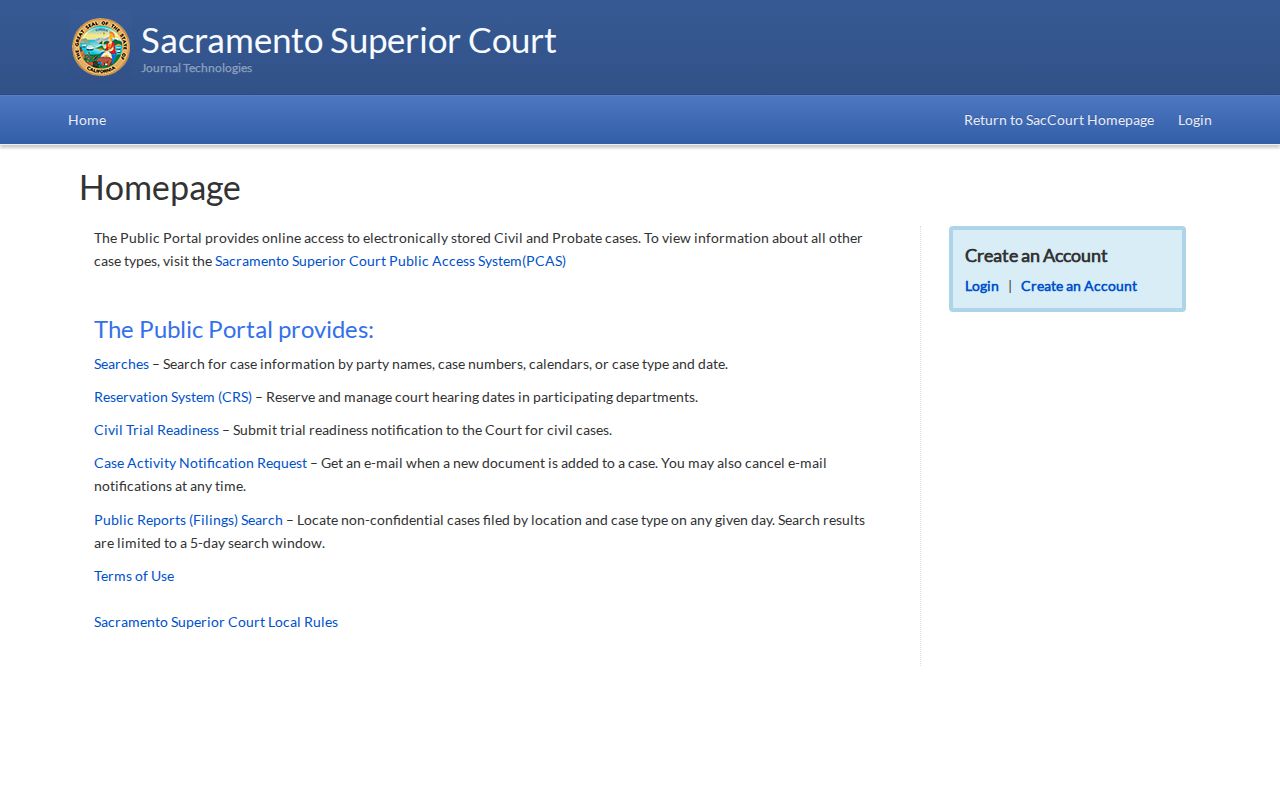
Its party, case, calendar, and type-date tools complement the older Criminal Public Case Access index.
Sacramento Name Search Limits
A name match in Sacramento Superior Court's index is a lead to a case file, not a fingerprint-confirmed identity. The court states that results depend on the exact criteria entered and that it cannot make a positive identification through fingerprint comparison. Similar names, spelling variants, and incomplete dates can therefore produce too many results or hide the right file.
Use a known case number whenever possible. If only a name is available, compare the filing date, court events, and other public case details without assuming that the person named in the result is the person sought. The Criminal Records Unit's $15 name search follows the same practical limit: it locates Sacramento County court records, but it does not turn a court index into a statewide identity check.
Note: California DOJ Record Review uses fingerprints for a person's own statewide history; Sacramento court search does not.
How a Criminal Case Moves
A case file begins when charges are filed, not merely when someone is arrested. At arraignment, the court addresses the charges and plea. Pretrial entries can include motions, hearings, and amended pleadings. The matter then reaches a plea, trial, dismissal, or other disposition. If there is a conviction, sentencing records the court's order. Some cases end before every stage.
Case flow: Charges Filed › Arraignment › Pretrial › Plea or Trial › Disposition › Sentencing
The docket should be read from start to finish. A complaint states allegations, while a disposition states what the court did. A plea is the defendant's answer to charges. An acquittal is a not-guilty verdict, and a dismissal ends a charge or case without a conviction on that count. Those terms prevent an initial accusation from being mistaken for the final result.
Sacramento Court File Versus Rap Sheet
The Sacramento Superior Court case file and a California DOJ record review answer different questions. The court file shows what happened in a filed local prosecution. A DOJ summary criminal history can include arrest, detention, disposition, and identifying data submitted by agencies and courts across California. DOJ ties its subject-review process to Live Scan fingerprints; the court's public name index does not.
For a person's own state record, follow the California DOJ Record Review process using Form BCIA 8016RR and Live Scan. If the issue is a missing or wrong court disposition in the DOJ record, obtain the relevant Sacramento County court document and use DOJ's challenge process. The court cannot erase or alter the state repository record simply because an online docket changed.
Case Record Access and Restrictions
California court records are presumed open unless a statute or court order restricts them. California Rules of Court 2.550 and following govern sealing. Sacramento County portals therefore do not reveal sealed or confidential records, protected juvenile material, or data removed through redaction. A missing online file may also be older than 1989, off-site, purged, or awaiting retrieval.
The California Public Records Act governs agency records, but a request to the Sheriff is not a way around court access rules. Local summary criminal history is restricted under Penal Code section 13300, and state summary history under section 11105. For a filed court document, ask the Criminal Records Unit about the precise case and copy channel. For an arrest report, use the arresting agency instead.